

Grounded Task Axes · Version 2

From Language to Manipulation: Composing Object-Centric Skills from Scratch.

GTA-2 turns high-level language instructions into executable, interpretable, and correctable robot manipulation skills through task-axis controller compositions—zero-shot, without task-specific demonstrations or training.

Initial Report · PDFPaper · Coming SoonCode · Coming Soon

01 · Task breadth

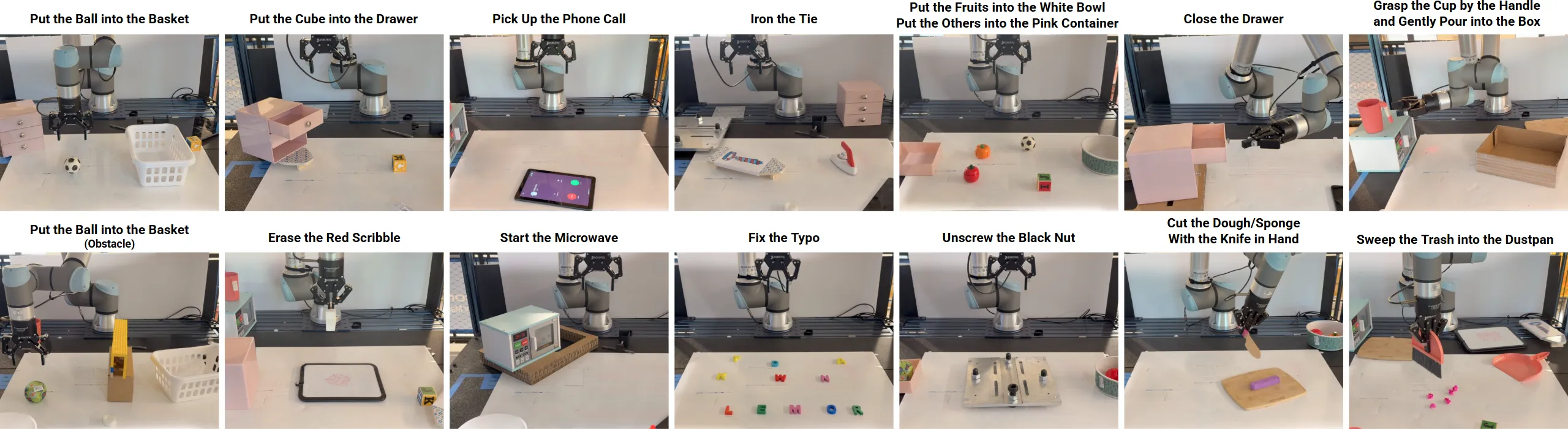
Fourteen different real-world tasks—
no demonstrations provided.

The benchmark spans contact-rich surface interaction and coverage, precision alignment and fastening, articulated-object and device operation, semantic ordering and multi-object organization, deformable-object manipulation, obstacle-aware pick-and-place, and pouring and material transfer.
Fourteen real-robot benchmark tasks evaluated in the GTA-2 study

14 generated-plan comparisons

  • 01 · Contact-rich surface interaction and coverage

    Erase the Red Scribble

  • 02 · Pouring, dispensing, and material transfer

    Grasp the Cup by the Handle and Gently Pour into the Box

  • 03 · Deformable object manipulation

    Cut the Dough/Sponge with the Knife in Hand

  • 04 · Precision alignment, insertion, fastening, and hanging

    Unscrew the Black Nut

  • 05 · Device operation

    Start the Microwave

  • 06 · Device operation

    Pick Up the Phone Call

  • 07 · Clutter cleanup and multi-object organization

    Sweep the Trash into the Dustpan

  • 08 · Basic pick and place for VLA

    Put the Ball into the Basket (There Is a Wall Obstacle in Between)

  • 09 · Clutter cleanup and multi-object organization

    Put the Fruits into the White Bowl / Put the Others into the Pink Container

  • 10 · Semantic reasoning and ordering

    Fix the Typo

  • 11 · Basic pick and place for VLA

    Put the Ball into the Basket

  • 12 · Basic pick and place for VLA

    Put the Cube into the Drawer

  • 13 · Contact-rich surface interaction and coverage

    Iron the Tie

  • 14 · Articulated objects and appliances

    Close the Drawer

GTA-2 · Video

Erase the Red Scribble

Contact-rich surface interaction and coverage

GTA-2 · Video

Grasp the Cup by the Handle and Gently Pour into the Box

Pouring, dispensing, and material transfer

GTA-2 · Video

Cut the Dough/Sponge with the Knife in Hand

Deformable object manipulation

GTA-2 · Video

Unscrew the Black Nut

Precision alignment, insertion, fastening, and hanging

GTA-2 · Video

Start the Microwave

Device operation

GTA-2 · Video

Pick Up the Phone Call

Device operation

GTA-2 · Video

Sweep the Trash into the Dustpan

Clutter cleanup and multi-object organization

GTA-2 · Video

Put the Ball into the Basket (There Is a Wall Obstacle in Between)

Basic pick and place for VLA

GTA-2 · Video

Put the Fruits into the White Bowl / Put the Others into the Pink Container

Clutter cleanup and multi-object organization

GTA-2 · Video

Fix the Typo

Semantic reasoning and ordering

GTA-2 · Video

Put the Ball into the Basket

Basic pick and place for VLA

GTA-2 · Video

Put the Cube into the Drawer

Basic pick and place for VLA

GTA-2 · Video

Iron the Tie

Contact-rich surface interaction and coverage

GTA-2 · Video

Close the Drawer

Articulated objects and appliances

02 · Overview

Manipulation stays explicit
from intent to control.

The system separates reasoning about what the task means from the geometric and control decisions required to execute it.

Most reusable robot skills are still large units: pick, place, open. GTA-2 composes below that level.

Sub-atomic composition means constructing each subtask from task-relevant keypoints, axes, constraints, and controllers—the reusable structure beneath a conventional primitive.
  1. 01

    Decompose task intent

    Expose semantic subtasks in an ordered, inspectable plan.

  2. 02

    Compose at the sub-atomic level

    Build each subtask from object-centric task-axis controller compositions.

  3. 03

    Correct locally

    Route feedback to the responsible stage while preserving decisions that are already correct.

Read the full abstract+

Robotic manipulation tasks are often decomposed into reusable behaviors or skills, yet these units can remain too coarse to expose the geometric, control, and scene-dependent decisions required for execution. We introduce Grounded Task Axes version 2 (GTA-2), a modular multi-agent vision-language model (VLM) framework that constructs executable manipulation skills from reusable object-centric task-axis components. Rather than predicting actions end-to-end or relying on predefined task-level skill primitives, GTA-2 explicitly represents manipulation structure through semantic subtasks, task-relevant keypoints and axes, controller compositions, and scene-dependent parameters. Four specialized VLM agents progressively decompose the task, generate an abstract task-axis skill, assign controller parameters, and ground the required visual features in an RGB-D observation. This separation between abstract skill construction and scene-specific instantiation enables zero-shot generation of new manipulation behaviors without task-specific robot demonstrations, policy training, or fine-tuning. Because the intermediate decisions remain explicit, users can also provide targeted feedback to the responsible agent while preserving components of the generated skill that are already correct. We evaluate GTA-2 on a real robot across 14 diverse manipulation tasks and compare it against the generalist VLA policy π0.5 and two Code-as-Policies baselines using either task-axis controllers or conventional robot primitives. GTA-2 achieves stronger zero-shot execution across the benchmark, while targeted refinement further improves and stabilizes skill generalization across scene configurations.

03 · Method
Four VLMs—each specialized
in a different aspect of manipulation.

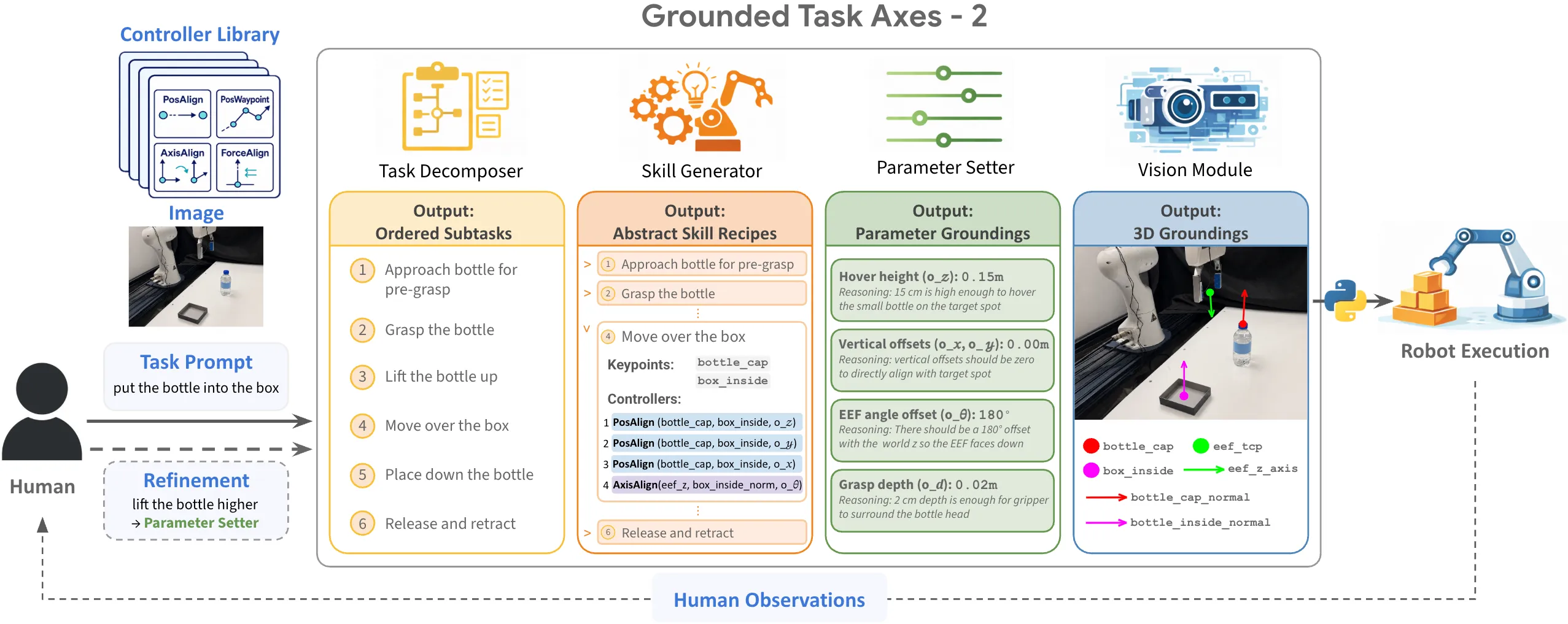
Four specialized VLM agents transform task intent into a grounded controller composition. Scroll to follow the representation as it becomes executable.
Task promptput the bottle into the boxRGB-D scene · controller library
Generated skill
01Approach bottle for pre-grasp+
02Grasp the bottle+
03Lift the bottle up+
04Move over the box
1PosAlign(bottle_cap, box_inside, o_z = 0.15 m)2PosAlign(bottle_cap, box_inside, o_y = 0.00 m)3PosAlign(bottle_cap, box_inside, o_x = 0.00 m)4AxisAlign(eef_z, box_inside_norm, o_θ = 180°)
Ptarget+Raxis+Fcontact+Gstate
05Place down the bottle+
06Release and retract+
00

Task prompt + RGB-D scene

Begin with a task instruction and an RGB-D scene.

The instruction specifies the desired outcome while the observation and reusable controller library provide the scene and action vocabulary used by the four agents.
Input
“put the bottle into the box”
Output
Inputs for the four-agent pipeline

Inputs

  • Task prompt: put the bottle into the box
  • RGB-D scene observation
  • Reusable task-axis controller library
01

Task Decomposer

Convert the instruction into ordered subtasks.

The Task Decomposer exposes the temporal and semantic structure of the manipulation behavior before any controller is selected.
Input
Task prompt + scene context
Output
Ordered Subtasks

Ordered Subtasks

  1. Approach bottle for pre-grasp
  2. Grasp the bottle
  3. Lift the bottle up
  4. Move over the box
  5. Place down the bottle
  6. Release and retract
02

Skill Generator

Map each subtask to an abstract skill recipe.

For each subtask, the Skill Generator selects symbolic object features, task axes, controller compositions, and priorities from the reusable controller library.
Input
Ordered subtasks + controller library
Task-axis controllers in execution
Output
Abstract Skill Recipes

Highlighted subtask

  • 04 · Move over the box

Keypoints

  • bottle_cap
  • box_inside

Controllers

  1. PosAlign(bottle_cap, box_inside, o_z)
  2. PosAlign(bottle_cap, box_inside, o_y)
  3. PosAlign(bottle_cap, box_inside, o_x)
  4. AxisAlign(eef_z, box_inside_norm, o_θ)
03

Parameter Setter

Assign the controller parameter groundings.

The Parameter Setter replaces symbolic placeholders with numerical values inferred for the observed task and scene.
Input
Abstract skill recipes
Output
Parameter Groundings

Parameter Groundings

  • Hover height (o_z): 0.15 m
  • Vertical offsets (o_x, o_y): 0.00 m
  • EEF angle offset (o_θ): 180°
  • Grasp depth (o_d): 0.02 m
04

Vision Grounder

Ground only the requested scene features.

The Vision Grounder instantiates the keypoints and axes requested by the lifted skill as metric features in the current RGB-D scene.
Input
Requested symbolic keypoints + axes
Output
3D Groundings
Output · 3D Groundings
Bottle and box scene with grounded keypoints and task axes

3D Groundings

  • bottle_cap
  • box_inside
  • eef_tcp
  • eef_z_axis
  • bottle_cap_normal
  • bottle_inside_normal
05

Robot-agnostic execution interface

Compile the grounded skill into robot execution.

The grounded task-axis skill is compiled into an executable robot script whose controllers are evaluated at runtime.
Input
Grounded task-axis skill
Output
Executable robot script

Runtime Commands

  • Position
  • Orientation
  • Force
  • Gripper

Inspect the source figure.

The web-native diagram now follows the paper’s bottle-to-box example and its intermediate outputs.

04 · Targeted refinement

Correct the responsible stage,
not the whole behavior.

Because intermediate decisions remain explicit, feedback can update decomposition, skill structure, parameters, or visual grounding independently.

15 scene configurations per task. Colored segments identify the responsible feedback stage; white segments are successful executions.

05 · Full results

Task generalization across fourteen
real-world manipulation tasks.

Success rates across 14 tasks and five methods, evaluated over 20 real-robot executions for each task–method pair.
Open accessible results table
Success rate by task and method, evaluated over 20 physical executions per task and method.
TaskOne-Success GTA-2Zero-Shot GTA-2Pi-0.5CaP-TACCaP-Primitive
Put the Ball into the Basket90%85%55%40%75%
Put the Cube into the Drawer100%85%40%45%60%
Pick Up the Phone Call100%75%5%40%45%
Iron the Tie85%75%0%30%45%
Put the Fruits into the White Bowl / Put the Others into the Pink Container85%75%5%20%40%
Close the Drawer90%65%10%40%40%
Grasp the Cup by the Handle and Gently Pour into the Box80%55%0%15%0%
Put the Ball into the Basket (Obstacle)95%80%35%45%55%
Erase the Red Scribble100%80%40%60%80%
Start the Microwave100%75%10%30%50%
Fix the Typo85%75%0%35%50%
Unscrew the Black Nut90%75%0%40%50%
Cut the Dough/Sponge with the Knife in Hand90%75%10%20%5%
Sweep the Trash into the Dustpan80%60%0%20%0%

Comparison with Pi-0.5 and the Code-as-Policies baselines.

06 · More behaviors

Additional robot behaviors
beyond the benchmark.

Additional trials probe open-world placement, geometric tool paths, underspecified language, small objects, and semantic destinations.
01

Semantic placement

Marker into a cup

A compact open-world placement behavior from a direct language instruction.
02

Tool trajectory

Draw a square around the ball

A geometric drawing request becomes a constrained waypoint trajectory.
03

Instruction ambiguity

A different interpretation

Given “Fix the typo,” GTA-2 arranges the loose letters into “TEACH” instead of correcting the word we had in mind. Well, that’s technically not incorrect…
04

Precision placement

Ping-pong ball into a bowl

A small-object grasp and placement behavior with a narrow target region.
05

Semantic grounding

Put the ball where it belongs

The system grounds a visually labeled destination from an underspecified request.

GTA-2 · Video

Marker into a cup

A compact open-world placement behavior from a direct language instruction.

GTA-2 · Video

Draw a square around the ball

A geometric drawing request becomes a constrained waypoint trajectory.

GTA-2 · Video

A different interpretation

Given “Fix the typo,” GTA-2 arranges the loose letters into “TEACH” instead of correcting the word we had in mind. Well, that’s technically not incorrect…

GTA-2 · Video

Ping-pong ball into a bowl

A small-object grasp and placement behavior with a narrow target region.

GTA-2 · Video

Put the ball where it belongs

The system grounds a visually labeled destination from an underspecified request.

GTA-2 · Video

Instruction → refinement → revised execution

The complete GTA-2 interface sequence, including task decomposition, controller composition, initial execution, targeted user feedback, and revised execution.

GTA-2 · Video

Pi-0.5 benchmark executions

Benchmark executions for the generalist vision-language-action baseline.

GTA-2 system architecture

Original GTA-2 architecture figure showing four VLM agents and robot execution

Targeted feedback progression

Original targeted feedback progression graph from the GTA-2 report

Full benchmark results

Original benchmark success rate graph across fourteen tasks and five methods