Pipeline architecture#
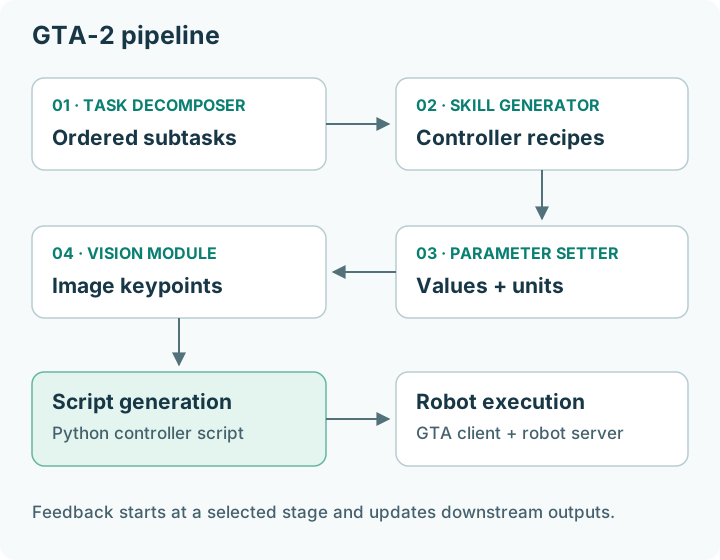
GTA separates planning, visual grounding, and execution. Planning produces structured descriptions; grounding locates their named keypoints in an image; generated code later combines 3D perception and robot state.
Agent responsibilities#
Task Decomposer: turn an instruction into ordered subtasks.
Skill Generator: choose controllers, priority, axes, and semantic keypoint descriptions for each subtask.
Parameter Setter: supply numeric values, units, and explanations.
Vision Module: locate the required visible keypoints and produce annotated image and JSON artifacts.
The message bus drives the downstream chain:
subtasks_updated → skills_updated → parameters_completed →
vision_completed. These are internal stage events, not robot commands.
The application tracks background handlers as well as its visible busy stage.
Where each responsibility lives#
Component |
Responsibility |
|---|---|
|
Model conversations, structured outputs, stage dispatch |
|
Workspaces, user interaction, checkpoints, process supervision |
|
Script generation, object geometry, controller projection, ROS publishing |
|
Compute task errors and control requests |
|
Camera, robot state/server/helpers, and gripper device interfaces |
At runtime, robot state is read through the selected state backend. For UR5e, this is RTDE Receive, not a ROS pose topic. Controllers compute errors using that state, and GTA publishes commands to the selected motion server.
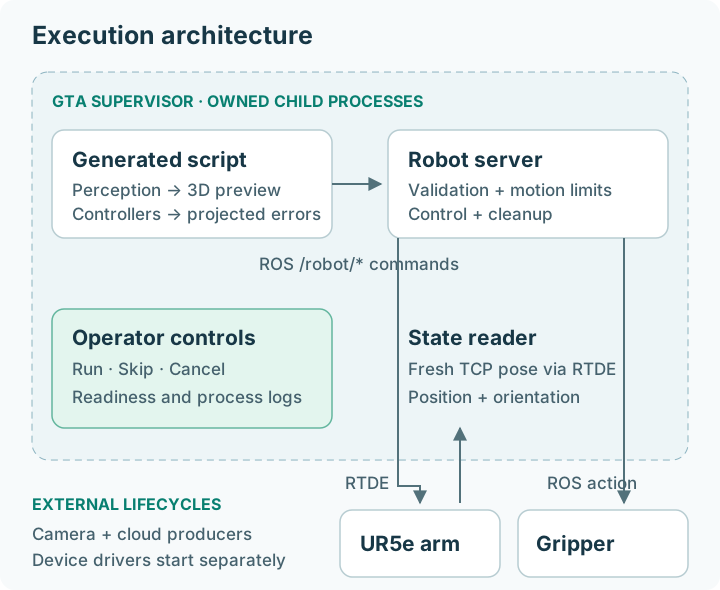
See controllers and priorities and runtime evaluation for computation details, and execution for the operator workflow.